13 March 2010

Panama - the one and only...entry!

Three weeks ago we arrived in this country connecting Central- and Southamerica and tomorrow we'll leave it behind, crossing the boarder on the Carribean side to Costa Rica. Time passes fast and we'd like to update you about our experiences in Panama.


Our first impression was that it is quite americanized: a lot of big trucks on the streets, McDonalds and many other famous fast-food-chains and a lot of overweighted people. In the shops the products are mostly american and the currency is the US dollar, only the coins are Balboas, but in the same denomination and value as the US cent.
Travelling in Panama is easy and comfortable, as the infrastructure such as the streets are in a very good condition. We both didn't know much of what to see in Panama besides the Canal and Bocas del Toro...but soon we realized that it has much more to offer:

Arriving in Panama City we were both glad to be back in a warmer place. The Casco Viejo in the city is interesting as you can see beautifully renovated old buildings right next to ruins which you think they might crash any minute. But of course the big thing to see is the Panama Canal.


A short taxi ride from town and you stand on the visitor platform of Miraflores Lock, one of the three locks (Schleuse) the ships have to pass through on the total 80 km linking the Atlantic and the Pacific oceans. The Canal was completed by 1914 under a US project team. The Republic of Panama finally took full control of the Canal in 1999, ending nearly a Century of american control. Three years ago they started the works of widening the Canal, and it's planned to have accomplished the works by 2014, hundred years after the first boat crossed the Canal.

Two days and a few hours westwards we stopped at El Valle, also called the crater vally because it lies in the crater of a enormous extinct volcano. It's a good base for hiking on some of the many trails.

On the photo you see one part of the forest covered crater and it's called La india durmida, the sleeping Indian. If you look at it properly you can discover the woman laying on her back with the face on the right hand side. It was a very enjoyable hike to the top, walking through lush forest, whereas on the top it was very volcanic with black rocks and arid landscape. And we didn't meet anybody until the bottom of the hill where some local men invited to have a beer with them :-)

After El Valle we headed down to the Panamerican Highway and 120km further west, back up to the hilly town of Santa Fé. Unfortunately the unusual heavy rainfalls cancelled most of our hiking plans, but as the town is VERY laidback and the pace very slow, we experienced three relaxing days at the hostal La Qhia.


As mentionned above, Santa Fé lies in the hills, the soil is very fertile with many delicious fruits growing abundantly, as well as coffee plants. The surroundings are fed by many rivers:  it's very cool to swim in their natural pools and enjoy the nearby waterfalls!

The next couple of busrides brought us to the Pacific Coast, to Santa Catalina known as surfers paradise with one of the best surfs in Panama. However we didn't see any professional surfers in action...only a few very goodlooking blond surfer dudes with a very well-trained body, walking topless in the streets...
Santa Catalina fortunately has more to offer than above named: it's also the gateway to Parque Nacional de Coiba, a few well-preserved islands 20km off the coast. We decided to go on a one day boat tour.


Getting there was a rather rough opportunity, but riding through the sea full of robinson-style islands, snorkelling with little sharks and rays and schools of fish made up for it easily! Talking about Isla Coiba, it's considered as the next Galapagos Islands! On the main island the Fauna is very diverse with all kinds of monkeys, birds and crocodiles...

One more time we headed up the hill, to the cooler place of Boquete. This town, located at the foot of Panamas highest point, Volcan Baru, has a very nice climate and is home to a lot of US and Canadian expatriots.


Again, this region offers perfect hiking opportunities and again the rain tried to destroy our plans of going for a walk out in the greens. But this time we headed off and walked along the very muddy and slippery Quetzal trail. Luckily, most parts of the 5-hour-trek were covered in dense forest, which is the habitat of the Quetzal bird.
The next day we relaxed at the close natural hot springs and the cold river just below. What a treat!

Guess where we went next? Yeah, down the hill to the coast again, but this time to the archipelago of Bocas del Toro on the carribean side!
The first two days in Bocas were very rainy. Actually it should be the driest month of the year but because of the famous Global Warming things are different. We still rented some bikes to visit a batcave and went for a little snorkeltour. Luckily on the third day the weather changed and we took the bus to the starfish beach across the island.


As the main island does not have nice beaches close to the town, we decided to hop on the boat and stay two nights on Isla Bastimentos where we really enjoyed beachtime and went on a boattrip to see dolphins, a very nice coral garden for snorkelling and to the famous Red Frog beach.
Unfortunatly the coral garden and the Red Frog beach are in big danger. The corals get destroyed by the many boats who are anchoring there every day in big numbers and the beach will be overrun by hundreds of big fat tourists who will stay at the almost finished luxurious Resort.
Today is our last night in Panama - we gonna enjoy a delicious Indian meal with a good bottle of white wine!

25 February 2010

Salento & Thousands of Wax Palms

Even though we left Colombia behind on the 19th of February we have to let you take part on our last Colombian experience!

When we arrived in Salento at 2000 meters, situated in the coffee region, we had as usual no big idea of how long we were going to stay. But on the second day we decided to book a cheap flight from the nearby Pereira to Panama which also meant that we definitely burried our plans of going to Panama by boat. So we knew that we have plenty of time to discover the many incredibly beautiful places around Salento.

First of all we got to see lots of really cool, colourful birds in the gardens of Plantation House, where we lodged. Among them one of our favourites, the tiny hummingbird...but do not worry we have not become fanatic birdwatchers...!
The owner of Plantation House also runs a small coffee farm. On a tour through the fields we got to know the most important things about growing colombian coffee.
And learned about the whole process from the red or yellow coffeebeans on the plants to the dried pale beans ready to be roasted. We also could wander around on the coffeefarm and see all the different other plants and fruits they grow there. Such as pineapples, bananas, blackberries, strawberries, lemons and oranges as well as a big bamboo forest.

Most of the people visit Salento because it is the gateway to the Valle de Cocora, famous for its wax palm (Ceroxylon quindiuense), which is the national tree of Colombia.
It is really weird to see palms at this altitude...the reason they grow there is because the wind carried the seeds all the way from the coast up to the highlands. The result are the forests full of up to 60 meters high palm trees, swaying gently as the wind blows. It is really cool to stand in the middle of it and watch to the top.
An other fantastic experience was our overnight stay up on 3000 meters on a remote farm (finca), only accessible by a four-wheel-drive car, by foot or by horse. Omar and his family lived from growing and harvesting potatoes but ten years ago they changed to cattle farming because of the climate change. You still can see the terraces all over the hills.
The dimension of their land is incredible...standing on a hill and looking around means you only see their property! We think something like that is impossible to see in Switzerland!
On the arriving day we visited one of the most beautiful places we found in Colombia. It is an other valley full of wax palms, but ten times more than in Valley the Cocora. It is a privat owend property and not developed for the tourism. It is a real secret that only locals know and only a few foreign tourists have been there. Omar told us we are around visitor number 50. This is the case because he just opend his farm for tourism about a month ago and he is the first farmer in this area who started the business. We are very happy that we got to know Omar, his family and that natural wonder!
Sorry, there are no good pictures from this area because it is not possible to picture that beauty.
On the second day we got an early start, milking the cows, drinking freshfresh milk with brandy...what a delight!
We are really glad that we could finish our Colombian travels by visiting this place!
By the way the name of this place is: EL ROCIO, whoever visits this area should ask us for the contact details!

19 February 2010

Feliz Cumpleaños HOMBRE !

Hombre haerzlechi Gratulation zum Geburtstag !
Leider hei mir nid mit Dir choenne astosse, drum hei die zwoei naette Duetsche muesse dra gloube...hehehe...

Cartagena and going South

As it is been long since our last entry and we have been to lots of great places AND as this is our last day in Colombia, we are going to post some fotos and describe briefly where it was and so on...


CARTAGENA DE LOS INDIOS

Cartagena is one of the most important and surely the biggest colonial city in Colombia.
On the first of February we had to say goodbye to our friend Dani, who flew back home.
We took the four hour bus to Cartagena and finally left Taganga behind.
Cartagena has a really beautiful and super clean old town where we enjoyed sightseeing and wandering around. But living in this part of town is totally overpriced as it is a major tourist attraction in Colombia.
After two days we were saturated of the big city life and headed off by boat to Playa Blanca. As the name says it is a classical beach with white, fine sand. It looks like an advertisement picture of a travel agencie. We wanted to escape the daytrippers and stayed overnight, sleeping in hammocks just by the water and eating fresh fish cooked by our lovely host Jose.
What else?


MOMPOX

Our first stop on the way South, Mompox is not the easiest way to reach. Bus, boat and taxi that is what you need to arrive in this hot, charming town at the banks of the mighty Magdalena river. There is not much to do, but we ended up staying four days because of the laid back athmosphere and its charme. Fourty degrees during the day forces the always smiling inhabitantes to take life slowly and relax in the famous Momposian rocking chairs.
In the evenings as the air cooled down to 29° or so, the main plaza is the place where the whole town gathers around the many foodstalls. The fairly cheap food allows them to also it out once in a while.
Trying all the different meals, such as Salchipapas, Pollo a la Plancha con Yucca, Butifarras, Perros calientes, Hamburguesas and Pizzas, drinking juices and local beers, chatting with fellow travellers and locals, turned out as our daily ritual in the evenings...


MEDELLIN

Famous throughout the world because of Pablo Escobar and his drug cartel.
Going further south we had to pass through this big and modern city.
On the first day we took advantage of the unique and very handy Metro whichlead us to some of the sights, as the botanical gardens and the recently built caple car connecting some outskirts with the city center.
Also we hanged around the Plaza Botero, home to more than twenty of Botero's sculptures. Botero ist Colombias most recognized painter and sculptor with an unique style - characterized by the abnormal fatness of his figures.
In the evenings wearing sweaters, long pants and sneakers, we enjoyed italian and mexican food inclusive a glass of vino tinto in Medellin's upperclass zone, the Zona Rosa.
We also have to mention that we found a real french baguette and prepared some delicious sandwiches for lunch...well, food is indeed very important and we could write a huge enty about this topic :-)
PS @ Dani: Sorry das mir kes Foeteli choei poste vo naette Silicones, hesch nid viu voerpasst, aes het fasch keni ume gha...


MANIZALES

Manizales is one of the three gateways to the Zona Cafetera.
We did not expect too much of the town itself but it turned out very funny because of Juan, an emloyee of the hostel, and his freaky friends. Most of them are Art and Design students at the uni and are "taging" and "graffiting" all over the town, they took us to a nice little lookout to watch the sunset and to a local Salsa bar. We also got to know how 20 to 24 year old students go out on a low budget: Botellones!
The first night we cooked some delicious veggie-ratatouille for some of them. They were very impressed about our preparation and loved it.
The second evening they introduced us to a local dish called Aborrajado, which is Plantain-patties filled with cheese and bocadillo, a sweet fruity gelee, covered in a dough and fried in a pan. Tambien muy delicioso pero con mucha grasa.
We also got to know a part of the amazing nature around Manizales...there are lots of green hills and it reminded us of the Swiss Emmental. We visited a natural park where we saw a garden with medical plants, a butterfly farm and finally an amazing forest full of beautiful orchids...Fabi was going crazy !

Grues ad Langethaler Fasnaechtler us uesem Dschungu...

Mir wuensche de Langethaler Fasnaechtler und bsungers am Pizzi ae fantastischi Fasnacht!
Ou mir hei aes paar Erfahrige im Dschungu gsammlet...
Heit Dir eigentlech no Schnee? Isch dr Umzug ueberhoupt mueglech oder gheit aer i Schnee?

06 February 2010

Parque Nacional de Tayrona

After a couple of days of recovering at the Tagangan beaches, sipping on delicious fruitjuices, we headed of to the nearby nationalpark of Tayrona. We were a group of five...us two, Dani, Isa and Nora from Zurich...
The public transport drops you of at the park entrance, from we walked 1.5hours to the campsite of Cabo de San Juan. Having arrived, we were surprised by the amount of people staying there. The Camping was almost full and we kind of could get the last five sleeping places in the hammocks...its acctually a comfy way of sleeping but this time was not as relaxing as there were no mosquito nets and its just full of these nasty insects! After two nights Danis face looked like teenage-acne...
The beaches though are very pretty with lots of clean white sand and cristal clear water. There are other places in the park to sleep but we decided to go to Cabo because you can swim there. Elsewhere its forbidden to swim due to strong and dangereous currents. So we experienced three quality beachdays in the park, having good chats and fun.
A very negative fact is the food...the best option is to bring and cook your own meals. As we did not have the right equipment, we had to rely on the only restaurant in the camp. Thats one reason we headed back to Taganga on the third day.

30 January 2010

Ciudad Perdida (Lost City)

We are very glad that we decided to go on this trek deep in the jungle. What we saw was simply amazing and breath-taking, so it was well worth the six days of sweat constantly running down the whole body.
The city was built between the 11th and 14th centuries, though its origens are much older, going back to perhaps the 7th century. Spread over an area of about 2 sq km it is the largest Tayrona (indigenous people) city found so far. Some 2000 to 4000 people are believed to have lived there.
During the Conquest, the Spaniards wiped out the Tayronas, and there settlements disappeared without a trace under lush tropical vegetation. So did Ciudad Perdida until its discovery by graverobbers in the early 1970s.
Ciudad Perdida lies on an altitude of between 950m and 1300m. The central part of the city is set on a ridge from which various stonepaths lid down to other sectors on the slopes. Although the wooden houses of the Tayrona are long gone, the stonestructures, including terraces and stairways, remain in remarkably good shape. (by Lonely Planet 2009)
The hike was pretty moderate. We covered 40km with a lot of up- and downhill... The only exhausting part was the heat. But you get used to it very quickly and during the day we regularly got supplied with thirst-quenching oranges, watermelons, pineapples and so on. We were a group of 11 people with a spanish speaking guide and two cooks. We all carried our own backpacks with our personal belongings and water. The first couple of days the food was transported by mules and on the third day the cooks carried the stuff on their back. The third day was also the most spectacular one! We had to cross the Buritaca river 9 times, which at this season is no big deal as the water is low. On the opposite...it was rather a relief for the feet usually stuck in the sturdy hiking boots. Then we had to climb the famous 2000 ...the number varies depending on who you ask...steps leading up to Ciudad Perdida. Fortunately it wasn't as tough as we expected - but the first glimpse on these many terrasses was stunning. And luckily we could take in the beauty of this site in peace, just our group with no other folks. IT WAS A MAGIC MOMENT!
On the way there are many differend camps with hammocks and mosquito nets, a basic kitchen and toilets/showers. So in the evenings we usually ate dinner at around six when it was almost dark and went to bed (to hammock...haha...) a couple of hours later. Its so calming to be able to fall asleep while hearing the sounds of the jungle.
What also makes the trek well worthwhile is the cooling off and swimming in the numerous natural pools along the trail. Whitout the daily stops at these places the trek would be less attractive.

16 January 2010

!!!! First impressions !!!!

Finally we're providing you with some first impressions of our travels in Colombia. As most of you know, stufabi and our friend (amigooooo) Dani met in Bogota....delayed by one day, as Fabi had to sleepover in Newark due to a false alarm and a partly evacuation of that US airport.

Spending some days in Bogota, we were wandering around to check out some major sights. Also we took a taxi to the district of Chico Norte, where we visited the swiss Yvonne & Harry. Thanks to their great knowledge about colombians must-sees, we figured out our travel route for this month.
All in all we were a bit unsure about safety matters during the first couple of days in the capital city. It was mostely because the locals kept telling us how dangerous it is especially after dark. However after two nights or so we figured out that it was not as bad as we were beeing told and we started to feel very comfortable and safe. And as soon as we left Bogota behind us, there have been no doubts anymore !
First stop on our journey northwards was Zipaquira, famous for its salt mine and the underground salt cathedral - > check out the foto;-) On the same day we bused to the colonial town of Villa de Leyva where we spent the night. As there were the Festivos de los Reyes (Holidays) in the whole country, many locals were hanging around in the streets, having some beers and having a good time. Of course we totally agree with them !
Before heading to San Gil, we went on a lovely early morning walk up the hills, through some amazing forests / jungles. Normally you could see waterfalls along the way, but as rainfalls have been very sparse lately, there was just a little bit of water flowing in the stream. Back in town, we found the best empanadas so far. For one time not fried, but baked in the oven. We are writing this, because food here is often fried, therefore quite greasy or something is wrong about it (see Danis Facebook status).
San Gil is Colombias outdoor capital...paragliding, river rafting, caving, repelling down the waterfall. However we didn't do any of those activities. We were just very happy to finally have arrived ...or beeing back for stufi and dani...in a warmer region. From now on we can say goodbye to socks and jeans and heavy blankets during the night;-). Taking San Gil as our base for the next 4 days, we visited some villages where we did some hikes and enjoyed the beautiful nature. We also did go to one of the nearby waterfalls where we swam in the natural pool and climbed down the canyon. Stunning moments in the nature !
On the 14th of January we took the bus to Parque National de Chicmocha in the morning, where we wanted to do a real walk for a few hours. Surprisingly, the park turned out as a tourist park for the rather rich Colombians with lots of attractions but not one possiblity for proper hiking or even walking...what a disappointment!
Anyway, after a while we took the next bus to Bucaramanga. During the ride Dani got to talk to Edith, a nice colombian girl, who later joined us for dinner. We had a really nice evening with a lot of laughing and left the town with the night bus heading to the Carribean cost. Wisely we brought our sleeping bag as we knew that night buses are usually cooled down to freezing temperatures.

So our current location is Taganga, a small village where stufi did the spanish clases in December. It's going to be our base until Dani leaves Colombia at the end of Janary. Tomorrow we leave Taganga for the next six days as we will be on famous trek to Ciudad Perdida - the Lost City.

01 January 2010

stufabi goes to Colombia

stufabi soon will be reunited !!!
and we can start another adventure !!!
stufi arrived in Colombia at the end of november, and spent the time studying spanish. fabi is leaving switzerland in a couple of days, heading to Bogota where she'll meet up with stufi !
together we'll travel this beautiful, amazing country - we are soooo excited to be back on the road again.

That's it for now ...news and pics will follow !

31 May 2008

stufabi goes to thailand

stufabi is leaving Nepal tomorrow and flies to Thailand. As the Thai-flag is pretty boring (don't you think?), we decided not to change our header and keep the pretty Nepali-flag...

In and around Kathmandu

Streetlife and Newari houses, Bandipur
On our way from Pokhara to Kathmandu we visited the small medieval town of Bandipur. A jewel off the beaten track where the omnipresent "one pen, one chocolate, one rupee"question hasn't reached yet. Bandipur's people are remarkably friendly and well educated which certainly is the result of an old-established school introduced by japanese nuns many years ago. An other evidence of the good education are the well kept Newari (the largest ethnic group in Nepal) buildings, temples and alleys. The main road very much reminded us of the old town in Murten, Switzerland.
During our stay we got to learn how to play the chess in Nepali-style. Hitting the enemies figures is much more important and more exciting than applying a strategy...
It's also an area short hikes such as climbing some of the several surrounding hills in order to catch a glimpse of the terraced landscape. An other walk lead us to a silkfarm which was a very rewarding experience because we got to know the process of gaining silk-thread.
The Stupas and Monastries of Bodhnath
If we had to decide of one symbol which pictures Nepal, it would be either an image of some mountains or the most visited Stupa of the country located in Bodhnath.
We lived there for a few days and entered several monastries, where the doors are open for visitors most of the time. Buddhism is indeed a very complex and true-to-life religion. Due to the big interest of western people, many monastries offer introductory courses. Unfortunatly we couldn't find any matching with our travel schedule. Nontheless, we found many opportunities to learn something about Buddhism while talking to different experienced Buddhists from Nepal or abroad.
Dhulikel
On the eastern edge of the Kathmandu-Valley, we stayed at the Nawaranga Guesthouse in Dhulikel. As most of the Nepali names have a beautiful meaning, so does Nawaranga: nine colours or colour of the rainbow.
The owner Purna (fullmoon) and his family are victims of the political unrest during the last 10 years. Their son got kidnapped by 4 years ago and is still missing. The daughter committed suicide. So Purna and his wife are now taking care of their 10 grandchildren.
Stories like that are also part of the fate of this country.
If anyone of you ever decides to visit Dhulikel ;-) we strongly recommend the dayhike to Namoboudha and Panauti. Even though it's only a 2 hour busride from Kathmandu there were hardly any tourists. The walk passes along small villages, cultivated fields (seem like all the villagers were busy harvesting potatoes), and finally the picturesque tre-storey-temples of Panauti.
A successful day in Patan
Since the day we arrived in Nepal we have been looking for a Singing Bowl. After having spent a lot of time doing research on the history, the usage and the actual value ;-), we realized that all bowls are manufactured in Patan. That's why we decided to finalise our research work on spot...
And we luckily did find a small shop whit a man who was very knowledgeable and reliable!
Yes, and now we are proud owners of a 2.5kg beautifully sounding Singing-Bowl!
What to DO in KathmanDU?
Eating, doing Yoga, chilling-out.
These three activities have been dominating our lives during the last week, completed by listening to livemusic, drinkin Gin-and-Tonics and shopping. So you can see, there is lots to DO in KathmanDU... ;-)
Often we were being joined by Michelle, a lovely Canadian, we met in Bandipur. Together we discovered our favourite restaurants in town with focus on (organic) salad variations. Of course we also were looking for places selling tasty local food and snacked around in various streetstalls.
Every other day early in the morning we tried to look good in different Yoga-postures...
Our american friend Chirag and the nepalese Yoga teacher Soumika recently set up a Yoga center. We really enjoyed these hours of moving our bodies smoothly.
Even though the exercises looked fairly easy we got up the following mornings with our muscles aching, longing for a day off...
...which we for example spent in the garden of dreams, a little oasis in the centre of Kathmandu but miles away from traffic an other disturbing noises.


10 May 2008

Wildlife & Buddhism & Rural Nepal

Kingfisher, Chitwan National Park
The only acceptable foto of the wildlife we saw on our jeep safari in Chitwan National Park is this beautiful Kingfisher. This bird is so famous that they even named a beer after it...Our Safari was a success as we could see the very rare, giant black sloth bear eating on termites only 20 meters away! Other animals we saw: crocodile, dotted deer, colourful peacocks and several other bird species. However we could not see the endangered one-horned-rhino which is one of the main attractions in this National Park.


Elephant riding, Sauraha (Chitwan National Park)

In Sauraha, the gateway town to the park and our lodging place, we enjoyed ourselves so much riding on the biggest animal on the earth!
Every day the elephants ot the town are going down to the river for their daily bath and whoever wants can join them to have fun in the cooling water. Oh yes, it was so refreshing to fall into lukewarm water, as the air was around 40 degrees.What we also got to feel is that elephant skin is much rougher than human skin...


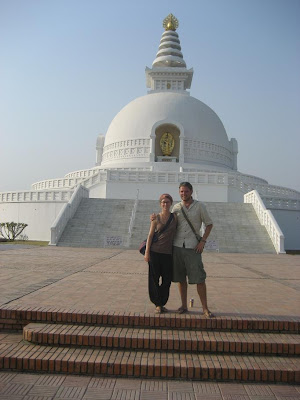
Stufabi in front of the World Peace Pagoda, Lumbini

Next destination was Lumbini, Lord Buddha Siddharta Gautama's birthplace (563bc). It is a pilgrimage place for Buddhists and Hindus as Buddha also is a reincarnation of the important Hindu god Vishnu.
The widespread development zone around birth site where Buddhist communities from all over the world build their monasteries and temples really is worth a visit. The white World Peace Pagoda for example was built by Japanese monks, the colourful ornamented door which Fabi tries to open :-) belongs to the Tibetan gompa and the huge praying roll Stufi is moving is located next to the German temple.
The effort of maintenance of the buildings and gardens varies a lot...some are in a very poor condition which is quite sad, but others are very well kept and it is a big pleasure to walk through the neatly arranged surroundings.


Man selling spices in a street in Pokhara


Stufi asking for directions, Pokhara

Here and then we rent some old style Indian bicycles with one gear...we love to explore the surroundings cycling! As the maps often are basic or rather not useful we count on the help of locals. Asking for directions using hands and feet can happen anywhere, even in the middle of a junction ;-)


Market, Tansen-Palpa
Escaping the heat, a winding road took us up to the medieval hill town of Tansen. Most parts of the old town are traffic-free because of the narrow and steep alleys. This fact requires the people to carry all the goods themselves.
Tansens main business is the weaving of a unique material which is seen all over Nepal. We visited one of the factories and were surprised how complicated the weaving-looms are built and how quick the workers handle these machines. At the market area you could buy all kinds of bags, clothes, hats, shoes etc. made out of this fabric.


Plumeria, Fabis favourite and all beloved flower...


We are very happy to still have three weeks left to continue our travels in this marvelous country.
The encounters with these beautiful and friendly people are always an enrichment, we truly love what we get to see and experience here.