30 January 2010

Ciudad Perdida (Lost City)

We are very glad that we decided to go on this trek deep in the jungle. What we saw was simply amazing and breath-taking, so it was well worth the six days of sweat constantly running down the whole body.
The city was built between the 11th and 14th centuries, though its origens are much older, going back to perhaps the 7th century. Spread over an area of about 2 sq km it is the largest Tayrona (indigenous people) city found so far. Some 2000 to 4000 people are believed to have lived there.
During the Conquest, the Spaniards wiped out the Tayronas, and there settlements disappeared without a trace under lush tropical vegetation. So did Ciudad Perdida until its discovery by graverobbers in the early 1970s.
Ciudad Perdida lies on an altitude of between 950m and 1300m. The central part of the city is set on a ridge from which various stonepaths lid down to other sectors on the slopes. Although the wooden houses of the Tayrona are long gone, the stonestructures, including terraces and stairways, remain in remarkably good shape. (by Lonely Planet 2009)
The hike was pretty moderate. We covered 40km with a lot of up- and downhill... The only exhausting part was the heat. But you get used to it very quickly and during the day we regularly got supplied with thirst-quenching oranges, watermelons, pineapples and so on. We were a group of 11 people with a spanish speaking guide and two cooks. We all carried our own backpacks with our personal belongings and water. The first couple of days the food was transported by mules and on the third day the cooks carried the stuff on their back. The third day was also the most spectacular one! We had to cross the Buritaca river 9 times, which at this season is no big deal as the water is low. On the opposite...it was rather a relief for the feet usually stuck in the sturdy hiking boots. Then we had to climb the famous 2000 ...the number varies depending on who you ask...steps leading up to Ciudad Perdida. Fortunately it wasn't as tough as we expected - but the first glimpse on these many terrasses was stunning. And luckily we could take in the beauty of this site in peace, just our group with no other folks. IT WAS A MAGIC MOMENT!
On the way there are many differend camps with hammocks and mosquito nets, a basic kitchen and toilets/showers. So in the evenings we usually ate dinner at around six when it was almost dark and went to bed (to hammock...haha...) a couple of hours later. Its so calming to be able to fall asleep while hearing the sounds of the jungle.
What also makes the trek well worthwhile is the cooling off and swimming in the numerous natural pools along the trail. Whitout the daily stops at these places the trek would be less attractive.

16 January 2010

!!!! First impressions !!!!

Finally we're providing you with some first impressions of our travels in Colombia. As most of you know, stufabi and our friend (amigooooo) Dani met in Bogota....delayed by one day, as Fabi had to sleepover in Newark due to a false alarm and a partly evacuation of that US airport.

Spending some days in Bogota, we were wandering around to check out some major sights. Also we took a taxi to the district of Chico Norte, where we visited the swiss Yvonne & Harry. Thanks to their great knowledge about colombians must-sees, we figured out our travel route for this month.
All in all we were a bit unsure about safety matters during the first couple of days in the capital city. It was mostely because the locals kept telling us how dangerous it is especially after dark. However after two nights or so we figured out that it was not as bad as we were beeing told and we started to feel very comfortable and safe. And as soon as we left Bogota behind us, there have been no doubts anymore !
First stop on our journey northwards was Zipaquira, famous for its salt mine and the underground salt cathedral - > check out the foto;-) On the same day we bused to the colonial town of Villa de Leyva where we spent the night. As there were the Festivos de los Reyes (Holidays) in the whole country, many locals were hanging around in the streets, having some beers and having a good time. Of course we totally agree with them !
Before heading to San Gil, we went on a lovely early morning walk up the hills, through some amazing forests / jungles. Normally you could see waterfalls along the way, but as rainfalls have been very sparse lately, there was just a little bit of water flowing in the stream. Back in town, we found the best empanadas so far. For one time not fried, but baked in the oven. We are writing this, because food here is often fried, therefore quite greasy or something is wrong about it (see Danis Facebook status).
San Gil is Colombias outdoor capital...paragliding, river rafting, caving, repelling down the waterfall. However we didn't do any of those activities. We were just very happy to finally have arrived ...or beeing back for stufi and dani...in a warmer region. From now on we can say goodbye to socks and jeans and heavy blankets during the night;-). Taking San Gil as our base for the next 4 days, we visited some villages where we did some hikes and enjoyed the beautiful nature. We also did go to one of the nearby waterfalls where we swam in the natural pool and climbed down the canyon. Stunning moments in the nature !
On the 14th of January we took the bus to Parque National de Chicmocha in the morning, where we wanted to do a real walk for a few hours. Surprisingly, the park turned out as a tourist park for the rather rich Colombians with lots of attractions but not one possiblity for proper hiking or even walking...what a disappointment!
Anyway, after a while we took the next bus to Bucaramanga. During the ride Dani got to talk to Edith, a nice colombian girl, who later joined us for dinner. We had a really nice evening with a lot of laughing and left the town with the night bus heading to the Carribean cost. Wisely we brought our sleeping bag as we knew that night buses are usually cooled down to freezing temperatures.

So our current location is Taganga, a small village where stufi did the spanish clases in December. It's going to be our base until Dani leaves Colombia at the end of Janary. Tomorrow we leave Taganga for the next six days as we will be on famous trek to Ciudad Perdida - the Lost City.

01 January 2010

stufabi goes to Colombia

stufabi soon will be reunited !!!
and we can start another adventure !!!
stufi arrived in Colombia at the end of november, and spent the time studying spanish. fabi is leaving switzerland in a couple of days, heading to Bogota where she'll meet up with stufi !
together we'll travel this beautiful, amazing country - we are soooo excited to be back on the road again.

That's it for now ...news and pics will follow !

31 May 2008

stufabi goes to thailand

stufabi is leaving Nepal tomorrow and flies to Thailand. As the Thai-flag is pretty boring (don't you think?), we decided not to change our header and keep the pretty Nepali-flag...

In and around Kathmandu

Streetlife and Newari houses, Bandipur
On our way from Pokhara to Kathmandu we visited the small medieval town of Bandipur. A jewel off the beaten track where the omnipresent "one pen, one chocolate, one rupee"question hasn't reached yet. Bandipur's people are remarkably friendly and well educated which certainly is the result of an old-established school introduced by japanese nuns many years ago. An other evidence of the good education are the well kept Newari (the largest ethnic group in Nepal) buildings, temples and alleys. The main road very much reminded us of the old town in Murten, Switzerland.
During our stay we got to learn how to play the chess in Nepali-style. Hitting the enemies figures is much more important and more exciting than applying a strategy...
It's also an area short hikes such as climbing some of the several surrounding hills in order to catch a glimpse of the terraced landscape. An other walk lead us to a silkfarm which was a very rewarding experience because we got to know the process of gaining silk-thread.
The Stupas and Monastries of Bodhnath
If we had to decide of one symbol which pictures Nepal, it would be either an image of some mountains or the most visited Stupa of the country located in Bodhnath.
We lived there for a few days and entered several monastries, where the doors are open for visitors most of the time. Buddhism is indeed a very complex and true-to-life religion. Due to the big interest of western people, many monastries offer introductory courses. Unfortunatly we couldn't find any matching with our travel schedule. Nontheless, we found many opportunities to learn something about Buddhism while talking to different experienced Buddhists from Nepal or abroad.
Dhulikel
On the eastern edge of the Kathmandu-Valley, we stayed at the Nawaranga Guesthouse in Dhulikel. As most of the Nepali names have a beautiful meaning, so does Nawaranga: nine colours or colour of the rainbow.
The owner Purna (fullmoon) and his family are victims of the political unrest during the last 10 years. Their son got kidnapped by 4 years ago and is still missing. The daughter committed suicide. So Purna and his wife are now taking care of their 10 grandchildren.
Stories like that are also part of the fate of this country.
If anyone of you ever decides to visit Dhulikel ;-) we strongly recommend the dayhike to Namoboudha and Panauti. Even though it's only a 2 hour busride from Kathmandu there were hardly any tourists. The walk passes along small villages, cultivated fields (seem like all the villagers were busy harvesting potatoes), and finally the picturesque tre-storey-temples of Panauti.
A successful day in Patan
Since the day we arrived in Nepal we have been looking for a Singing Bowl. After having spent a lot of time doing research on the history, the usage and the actual value ;-), we realized that all bowls are manufactured in Patan. That's why we decided to finalise our research work on spot...
And we luckily did find a small shop whit a man who was very knowledgeable and reliable!
Yes, and now we are proud owners of a 2.5kg beautifully sounding Singing-Bowl!
What to DO in KathmanDU?
Eating, doing Yoga, chilling-out.
These three activities have been dominating our lives during the last week, completed by listening to livemusic, drinkin Gin-and-Tonics and shopping. So you can see, there is lots to DO in KathmanDU... ;-)
Often we were being joined by Michelle, a lovely Canadian, we met in Bandipur. Together we discovered our favourite restaurants in town with focus on (organic) salad variations. Of course we also were looking for places selling tasty local food and snacked around in various streetstalls.
Every other day early in the morning we tried to look good in different Yoga-postures...
Our american friend Chirag and the nepalese Yoga teacher Soumika recently set up a Yoga center. We really enjoyed these hours of moving our bodies smoothly.
Even though the exercises looked fairly easy we got up the following mornings with our muscles aching, longing for a day off...
...which we for example spent in the garden of dreams, a little oasis in the centre of Kathmandu but miles away from traffic an other disturbing noises.


10 May 2008

Wildlife & Buddhism & Rural Nepal

Kingfisher, Chitwan National Park
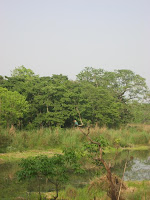
The only acceptable foto of the wildlife we saw on our jeep safari in Chitwan National Park is this beautiful Kingfisher. This bird is so famous that they even named a beer after it...Our Safari was a success as we could see the very rare, giant black sloth bear eating on termites only 20 meters away! Other animals we saw: crocodile, dotted deer, colourful peacocks and several other bird species. However we could not see the endangered one-horned-rhino which is one of the main attractions in this National Park.


Elephant riding, Sauraha (Chitwan National Park)

In Sauraha, the gateway town to the park and our lodging place, we enjoyed ourselves so much riding on the biggest animal on the earth!
Every day the elephants ot the town are going down to the river for their daily bath and whoever wants can join them to have fun in the cooling water. Oh yes, it was so refreshing to fall into lukewarm water, as the air was around 40 degrees.What we also got to feel is that elephant skin is much rougher than human skin...


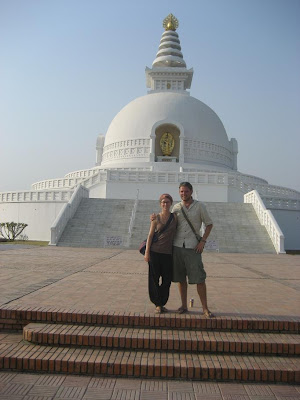
Stufabi in front of the World Peace Pagoda, Lumbini

Next destination was Lumbini, Lord Buddha Siddharta Gautama's birthplace (563bc). It is a pilgrimage place for Buddhists and Hindus as Buddha also is a reincarnation of the important Hindu god Vishnu.
The widespread development zone around birth site where Buddhist communities from all over the world build their monasteries and temples really is worth a visit. The white World Peace Pagoda for example was built by Japanese monks, the colourful ornamented door which Fabi tries to open :-) belongs to the Tibetan gompa and the huge praying roll Stufi is moving is located next to the German temple.
The effort of maintenance of the buildings and gardens varies a lot...some are in a very poor condition which is quite sad, but others are very well kept and it is a big pleasure to walk through the neatly arranged surroundings.


Man selling spices in a street in Pokhara


Stufi asking for directions, Pokhara

Here and then we rent some old style Indian bicycles with one gear...we love to explore the surroundings cycling! As the maps often are basic or rather not useful we count on the help of locals. Asking for directions using hands and feet can happen anywhere, even in the middle of a junction ;-)


Market, Tansen-Palpa
Escaping the heat, a winding road took us up to the medieval hill town of Tansen. Most parts of the old town are traffic-free because of the narrow and steep alleys. This fact requires the people to carry all the goods themselves.
Tansens main business is the weaving of a unique material which is seen all over Nepal. We visited one of the factories and were surprised how complicated the weaving-looms are built and how quick the workers handle these machines. At the market area you could buy all kinds of bags, clothes, hats, shoes etc. made out of this fabric.


Plumeria, Fabis favourite and all beloved flower...


We are very happy to still have three weeks left to continue our travels in this marvelous country.
The encounters with these beautiful and friendly people are always an enrichment, we truly love what we get to see and experience here.

28 April 2008

Annapurna-Trekking

As we wrote in the last entry we went on a 10-Day-Trek in the Annapurna-Region...IT WAS AMAZING !!!

ANNAPURNA 1 - 8091m - View from Lete

On the starting day we first drove by car for about 1 hour to Nayapul, which is the town where you have to enregister with ACAP, the Annapurna Conservation Area Project, before starting the trekking. As we decided to walk with a guide, we didn't have to worry about the paper work;-) Talking about the guide: he's name is Kopil and he lead us thru the mountains, giving us some precious information about the peaks, local people, religion and made us laugh with his funny behaviour. In this area it really is not necessary to be guided, as the trails are very well maintained and obviously marked and the guesthouses, called teahouses, are widely spread out along the tracks. Even though April is a good time for hiking in this part of the Himalayas, we never had any troubles to find a bed to sleep and food to fill our empty stomachs. Our idea in hiring a guide was mainly the benefit of getting interesting background information, which at the end was rather disappointing and not worth the money, because our man was not one of the experienced ones and his english skills ware pretty basic. But at least we supported a local family (Kopil is a part-time university student and a proud father of a daughter)!

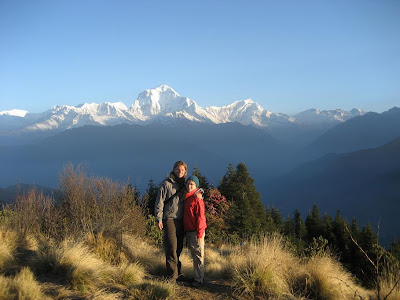
On day three at 4.30 in the morning we started walking up to Poonhill, one of the most famous lookout-points in the Annapurna range, to see the sunrise. We were blessed by superb weather conditions...so we not only could admire the view, but also see the six stripes of the Himalayas before the sun rised over the peaks. What a unique moment!!!

It didn't matter that hundreds of other trekkers from all over the world shared that time up there with stufabi. Happiness was written in everyone's face that morning...

The day before climbing Poonhill, we were walking seven hours with 1200m difference in altitude, constantly ascending. After descending from Poonhill, eating cornbread and drinking milktea for breakfast, we continued walking downhill to the village of Tatopani, 1200m lower and seven hours further. This was quite a bit of work for our legs and shoulders, and at the same time our thoughest two days. This torture absolutely was rewarded by the mentionned Poonhill-views, as well as passing thru blooming rhododendron-forests and coming along waterfall landscapes forming pools with cristalclear, icecold mountainwater.

It was also very interesting to see how the hilltribes live and how they are able to grow different grains (corn, wheat), vegetables (cauliflower, potatoes, pumpkin, tomatoes, onions, spinach) and fruits (apples, apricots, almonds) in barren earth.

Most of those tribal people have tibetean roots. It can easily be seen in their different clothing, the colourful jewellery the women wear, the art, and the religion which is Tibetean Buddhism. Praying flags are waving everywhere, Praying rolls are installed in every tiny little village and Bhudda's Eyes are watching you from all over...


stufabi in front of DHAULAGIRI - 8167m - View from PoonHill